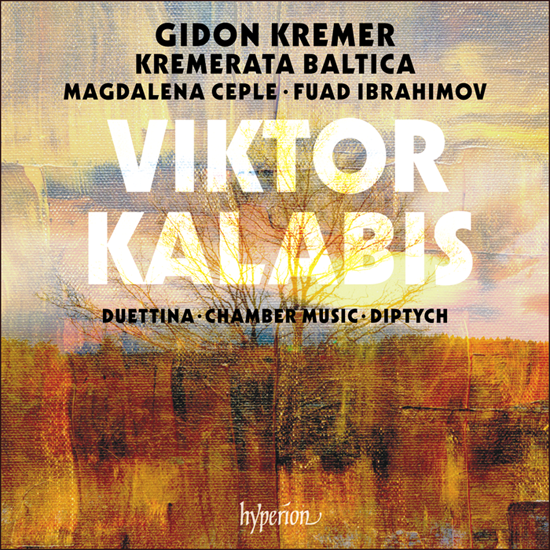
Release of the CD: “Kalabis: Duettina, Chamber music & Diptych“
The international harpsichordist Zuzana Růžičková once said that she had a
dream that Gidon Kremer and his Kremerata Baltica orchestra would record works by her late husband, the
Czech composer Viktor Kalabis. That dream has come true: Kalabis: Duettina, Chamber music & Diptych
is out now on Hyperion.
This release of Kremer’s recordings of important works by Kalabis underscores the composer’s importance in
20th-century classical music. These new recordings come at a time when the world confronts rising
authoritarianism and the undermining of freedom from tens of millions of people. The lives of Zuzana and
Viktor were immeasurably impacted by the ruthless regimes that governed their country for 50 years, first the
Nazis and then the Communists. The experiences are evident in the three compositions that Gidon Kremer
and his colleagues play.
Yet, Kalabis was a romantic with a passionate love for the place where he was born and where he did so much
of his work, Bohemia. He and Zuzana had the opportunity to flee Prague as the Russian army invaded to crush
the “Prague Spring” in 1968, but Viktor simply could not imagine being able to compose anywhere else than in
his beautiful Bohemia. This passion also is evident at times in these recordings.
Viktor and Zuzana both refused to join the Czech Communist Party and they suffered for it. Viktor could travel
only rarely and could not secure a prominent position as a teacher or conductor, while his music could not
secure the international prominence that it deserved. Viktor died in 2006 and thereafter Zuzana – who was the
first harpsichordist to record the complete keyboard works of Bach – dedicated herself to ensuring that his
compositions attained international attention. There have been several recordings of Viktor’s works in recent
years; this new set by Gidon Kremer adds to the growing collection.
Gidon Kremer remarks,
“I am very happy that the dream of the wonderful harpsichordist Zuzana Růžičková
has now come true — and indeed that we could promote and support the music of her husband, Viktor Kalabis,
a very good composer. And I am grateful to my team, to the Kremerata Baltica, to conductor Fuad Ibrahimov,
cellist Magdalena Ceple and with the support of the Viktor Kalabis and Zuzana Růžičková Foundation, that we
were able to make this recording. I hope you will enjoy it.
”
Viktor Kalabis was a prolific composer, writing five symphonies and seven string quarters alongside many
concerti and chamber works. His music functions tonally, but he concocted a method of his own for weaving
twelve-tone thinking through a score, usually with the intention of intensifying harmonic light and shade, or to
walk the music along new and more unstable pathways. Whichever technical procedures he adopted, the
essence of Kalabis’s music remained the same and retained its instantly recognizable sound.
The earliest piece on this new album, the Chamber music for strings, Op 21, was written in 1963 and orbits
the same mournful, elegiac mood-music of his String Quartet No 2, completed a year previously. When Kalabis
completed his Diptych for strings, Op 66, over twenty years later, in 1987, he saw the piece as following in a
lineage that reached back to his Chamber music for strings, both pieces having been scored for twelve strings.
Inspiration for the piece had derived from the design of Ancient Greek “diptycha,
” pairs of wax writing tablets,
secured down the middle with strings, often used for official or legal business. The Diptych was a study in
string sonority more than an overtly emotional statement, an abstract composition about only its own material.
Kalabis kept flexing that string muscle in his next work, a set of four miniatures — the Duettina for violin and
cello, Op 67, also written in 1987, and commissioned by violinist Jana Vlachová and cellist Mikael Ericsson —
which dwell largely in the same high-velocity world as the final movement of his Diptych.
More information on the music of Viktor Kalabis can be found at www.kalabismusic.org.